
For Tier 1 contractors, reputation hinges on project efficiency, legal compliance, and an impeccable safety record. In the high-stakes environment of large-scale construction, a proactive approach to security and site hoarding is the optimal option.
We will explain here why it is a strategic imperative to integrate advanced hoarding design and comprehensive security planning to manage risk effectively, meet the demands of the Construction (Design and Management) Regulations 2015 (CDM), and ensure a safe, compliant, and professional project delivery.
Hoarding defines the relationship between your high-risk site and the outside world. For Tier 1 companies, the focus shifts from basic exclusion to risk mitigation, public relations and sustainability.
CDM and Safety Obligations
The primary legal driver is the duty to protect the public under the CDM Regulations (Reg. 18).
- Controlling the Boundary: Hoarding must create a robust, impenetrable physical exclusion zone to prevent unauthorised access—especially crucial in high-footfall urban environments.
- Hazard Containment: The barrier must contain dust, noise, and site-generated debris, demonstrating due diligence to local authorities and mitigating public liability exposure.
- Structural Integrity (Temporary Works): Construction projects require hoarding to be designed and installed as a temporary works structure. This necessitates a formal design process, including wind-loading calculations (as per TWf guidance) and a signed-off by a suitably qualified and competent person to ensure stability under all weather conditions.
Security by Design
In certain sectors, the hoarding system is the crucial interface between the construction site and a live, secure operation. For Ministry of Defence (MOD) or the Ministry of Justice (MOJ) projects, such as prisons, custodial facilities, or defence infrastructure, security and hoarding must be integral.
When undertaking refurbishments or new builds, the hoarding must serve two critical, often conflicting, purposes:
- Segregation and Privacy: The hoarding must prevent any interaction between contractors/materials and the people within, eliminating all footholds, handholds and gaps that could be exploited for illicit activities.
- Internal Security and Fire Safety: For internal works (e.g. Fire Safety Improvements), modular, fire-rated hoarding (often EI60-rated) is required to safely partition the construction zone from operational wings, maintaining strict fire compartmentalisation and preventing disruption to the facility’s routine, using non-combustible materials.
Projects on military bases or sensitive defence sites demand a multi-layered security approach where the hoarding is a primary security asset:
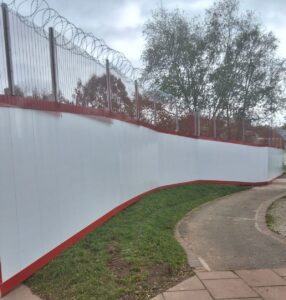
- Enhanced Intrusion Resistance: Hoarding systems are often specified with additional anti-climb features, such as increased height (up to 3m), specialised angled extensions, or heavy-duty materials (e.g. steel palisade) that deter determined intruders.
- Vetting Integration: Perimeter access gates must be designed to integrate seamlessly with enhanced security measures, such as turnstiles and biometric readers, and managed by fully security-cleared personnel (e.g., SC/CTC/EL1). The hoarding itself acts as a clean canvas, free of information that could inadvertently compromise site operations.
Leveraging Specialist Solutions
For complex or longer-term projects, outsourcing hoarding installations to experts like Topan Group ensures that the system is engineered to the highest standards, adapting to dynamic site phases whilst maintaining compliance.
Topan Group addresses the diverse needs of Tier 1 projects through a strategic variety of hoarding and security solutions:
1. Hoarding Material and Sustainability Choices
Tier 1 companies require solutions that meet stringent environmental mandates:
- uPVC Hoarding (The Circular Economy Choice): This modular system, often made from recycled and fully recyclable materials, offers rapid deployment, clean dismantling, and high durability for future reuse across multiple projects. This directly contributes to project sustainability targets and carbon reduction commitments.
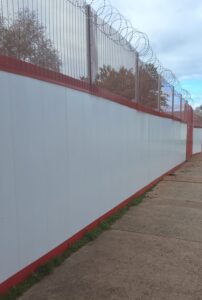
- Integrated Security Hoarding: Providing high-security, structural panels designed for the seamless integration of anti-climb security fencing (razor wire, mesh extensions, or angled deterrents) to the top edge. This creates a multi-layered boundary that significantly enhances intrusion resistance, especially crucial for sensitive or high-risk sites.
2. Versatile Fixing and Temporary Works Systems
Tier 1 projects often have complex ground conditions, demanding adaptive engineering:
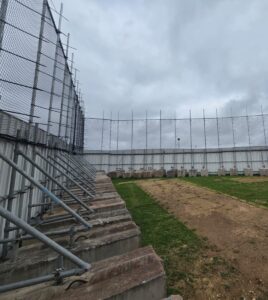
- Kentledge System (Non-Invasive Fixing): Ideal for restricted or phased sites where breaking ground is prohibited (e.g. over underground services or existing concrete slabs). This above-ground, weighted system allows for easy, low-impact relocation as the site develops.
- Dug-in Posts: Used for long-term, high-exposure boundaries, providing maximum stability against environmental loading.
- Bolt-Down Steel Posts: Preferred for urban sites where hoarding must be anchored securely to existing hardstandings, offering a rigid, tamper-resistant perimeter.
3. Integrating Access and Permanent Security
A perimeter system must be fully integrated with site access control protocols:
- Bespoke Vehicle and Pedestrian Gates: Custom-fabricated, secure entry and exit points are essential for managing high volumes of materials and personnel and for integrating with digital access control systems.
- Permanent Security Fencing: Where the boundary will remain in situ post-completion (e.g. utility compounds), robust, anti-climb solutions like palisade fencing and high-security welded mesh are durable and ensure longevity.
Integrating Technology and Procedures
1. Advanced Technological Deterrence
Modern technology can integrate with the hoarding system for immediate intrusion detection, providing the earliest warning of a breach:
- Smart CCTV Surveillance
- Motion sensors
- Perimeter Alarms
- LiDAR or vibration sensors
- Facial recognition
2. Rigorous Access Control and Vetting
Security begins by taking control over who enters and exits the site:
- Digital Access Systems: Implementing a single, highly secure point of entry, managed by biometric or smart card access control and integrated with the site attendance system, provides a real-time, auditable trail.
- Tool and Material Management: Enforcing strict, documented procedures for the use, movement and secure storage of small plant and tools in heavy-duty, lockable steel storage vaults when the site is operational and closed.
Conclusion
For a Tier 1 contractor, the cost of inadequate security is measured in crippling project delays, liquidated damages, insurance premium spikes, a compromised reputation and irreparable damage to client trust. The investment in strategically planned hoarding and advanced integrated security is fundamentally an investment in delivering a compliant, safe and successful project.
By partnering with specialists to deploy engineered, sustainable hoarding systems and backing them with intelligence-driven security technology—particularly in high-security, compliance-heavy sectors—UK Tier 1 contractors effectively mitigate public risk, ensure regulatory compliance (CDM), and protect their most valuable assets.
At Topan, we are committed to providing bespoke, high-performance uPVC hoarding systems that deliver on every front. Our fully recycled and recyclable hoarding is designed to comply with legal and environmental requirements as well as your security needs. Don’t let your hoarding be an afterthought.
Don’t sit on the fence; contact us!