
The choice of system to support the entire line of hoarding will depend on several factors, such as ground level, services, space and the possibility of repositioning the hoarding during the project’s life. However, the strength of a temporary hoarding project begins with solid, reliable foundations.
So, cost considerations apart, should you choose Kentledge (on-ground) or a more traditional Dug-in (in-ground) system for your project?
We’ll guide you through the key aspects to help you choose the right option without compromising performance or budget. Understanding the differences between system types is essential to maximising site efficiency and minimising environmental impact.

Difference Between Kentledge and Dug-In
When a temporary hoarding line is up, it is exposed to various elements, such as wind and crowd loading. It is crucial to understand how both systems handle these elements before comparing costs.
1. Kentledge System (Above-Ground)
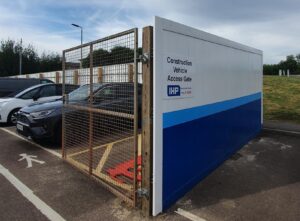
A Kentledge system uses heavy pre-cast concrete blocks to provide stability through gravity and friction. The hoarding panels are secured to a frame weighted by these blocks.
- Suitable for: Urban street works, areas with high utility density and sites where ground penetration is prohibited, generally in areas where there is a high density/probability of utilities.
- Not suitable for: steep gradients and soft grounds.
A primary concern for any contractor is the risk of accidental strikes on buried services. Even with CAT and Genny scanning, diggingcan introduce unnecessary risk; Kentledge systems offer a zero-penetration solution that does not compromise underground assets.
Also, projects often involve moving boundaries as work progresses. A Kentledge system can be dismantled and relocated in hours. Furthermore, the costs and the need for local authority permits for pavement repairs are eliminated.

2. Dug-In Hoarding Systems (In-Ground)
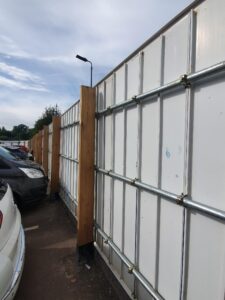
This method involves excavating holes (800mm–1,200mm deep) and securing timber or steel posts with concrete or post-mix to anchor the recycled uPVC hoarding panels.
- Suitable for: sites with severe space or topographic restraints.
- Not suitable for: utility dense areas or sites where the ground cannot be disturbed.
For locations where space is at a premium, or in rural areas with uneven or soft ground, in-ground foundations are a great choice. A dug-in system is ideal for these areas, as posts can be adjusted to create a level, secure, and continuous fence line.
Benefits of Choosing the Right System
- Cost control: choosing the right system negates future replacement due to external elements like weather. Kentledge is quicker to install and could offer the possibility of being reused on another project.
- Safety: one of the main purposes of hoarding is to protect the public from potential site hazards whilst keeping workers safe; choosing the right system enhances this aspect.
- Adaptability: both systems have different installation techniques, so either one or both will be compatible with the project’s specific requirements.
- Minimise disruptions: for some projects, noise can be an issue; for others, traffic or accessibility can complicate installation. As Kentledge doesn’t require digging, this minimises noise disruption. Both systems are delivered with their core components and installed on-site, reducing the need for road closures.
- Speed of installation: cost may not be the primary driver; speed is required.
- Sustainability: the Kentledge system lends itself to being reused multiple times on other projects. With Dug-in, some elements, such as the boards and potentially fixings, can be reused, but the posts are generally single-use.
Compliance
This is an aspect that can’t be overlooked. In the UK, all site hoarding must comply with BS EN 1991-1-4 (wind actions). Failing to provide structural calculations can lead to HSE interventions or, worse, site failure.
- Predictable Stability: The weight of a Kentledge block is a known constant. This makes wind loading calculations straightforward and highly accurate.
- Soil Variables: The strength of a dug-in post depends entirely on soil conditions, which can weaken significantly due to seasonal weather and over time.
Engaging a specialist like Topan ensures your hoarding, whether Kentledge or Dug-in, is supported by site-specific calculations, shielding you from potential liability (providing the installation is completed as per the calculation,s and any alterations are agreed and completed by the installer).
Comparison Table
|
Operational Factor |
Kentledge |
Dug-In |
|
Risk of Utility Strike |
Minimal |
High |
|
Space Footprint |
Moderate (Concrete blocks) |
Minimal |
|
Installation Speed |
Rapid |
Slow (Requires Curing) |
|
Reinstatement Cost |
Negligible |
Possible |
| Environmental Impact | Low
(Reusable) |
High (Material & waste Intensive) |
A Note About Sustainability
The UK construction industry is under pressure to reduce waste. Traditional timber hoarding is frequently sent to landfill after a single use.
By opting for Topan’s fully recyclable uPVC hoarding, paired with Kentledge blocks, you contribute to a circular economy. The concrete blocks have a lifespan of decades, and the panels can be granulated and remanufactured at the end of their life cycle. This is a significant green tick when tendering for public-sector and/or environmentally conscious contracts.
The right choice with Topan
Whilst the Dug-in system has its place on steep slopes, the Kentledge system is the clear winner for urban construction projects. Topan provides the expertise, knowledge and capacity to partner with you to identify the best hoarding solution for your project.
At Topan, we are committed to providing bespoke, high-performance uPVC hoarding systems that deliver on every front. With our fully recycled and recyclable solutions, we offer a full-service approach, from initial consultation to installation and maintenance, giving you peace of mind.
Don’t let your hoarding be an afterthought. Contact us today to discuss how our solutions can help you build safer, more sustainable and more successful projects.
Don’t sit on the fence; contact us!